The essentials in 30 seconds
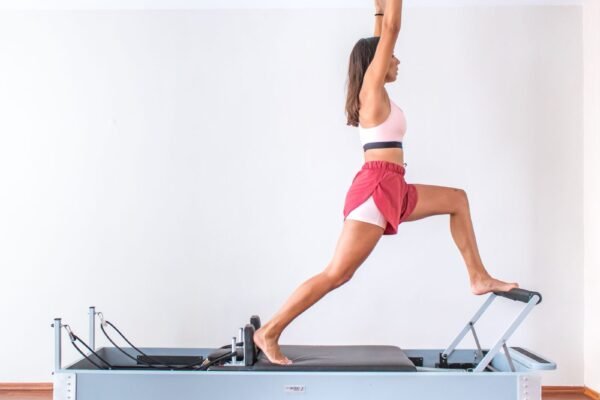
- The reformer is a Pilates machine: a carriage that rolls on rails, held back by springs, with a bar for the feet and straps for the hands or feet.
- The springs help or resist movement. The same exercise can therefore be made easier for a beginner, or harder for an athlete.
- What you can reasonably expect from it: stronger deep muscles, more mobility, better postural awareness. Not spectacular weight loss.
- Allow two or three sessions per week for several weeks before judging. Start in a supervised class if you have pain, are pregnant, or have had a recent operation.
You’ve probably seen it on Instagram: a long wooden or aluminum machine, someone lying on it, feet in straps, and a carriage gliding slowly back and forth. That’s a reformer, and it’s now the most requested version of Pilates in studios.
Behind the trend, the machine is over a hundred years old and has a very simple logic. Here’s how it works, what it changes compared to mat Pilates, and what you can honestly expect from it, without any miracle promises.
What exactly is a reformer?
A reformer is a rectangular frame, about 2.40 m long for a studio model, on which a padded carriage slides. This carriage is connected to the end of the frame by springs. When you push with your feet or pull on the straps, the carriage moves away and the springs stretch. When you return, they pull you back: you have to control the return, and that’s where the work happens.
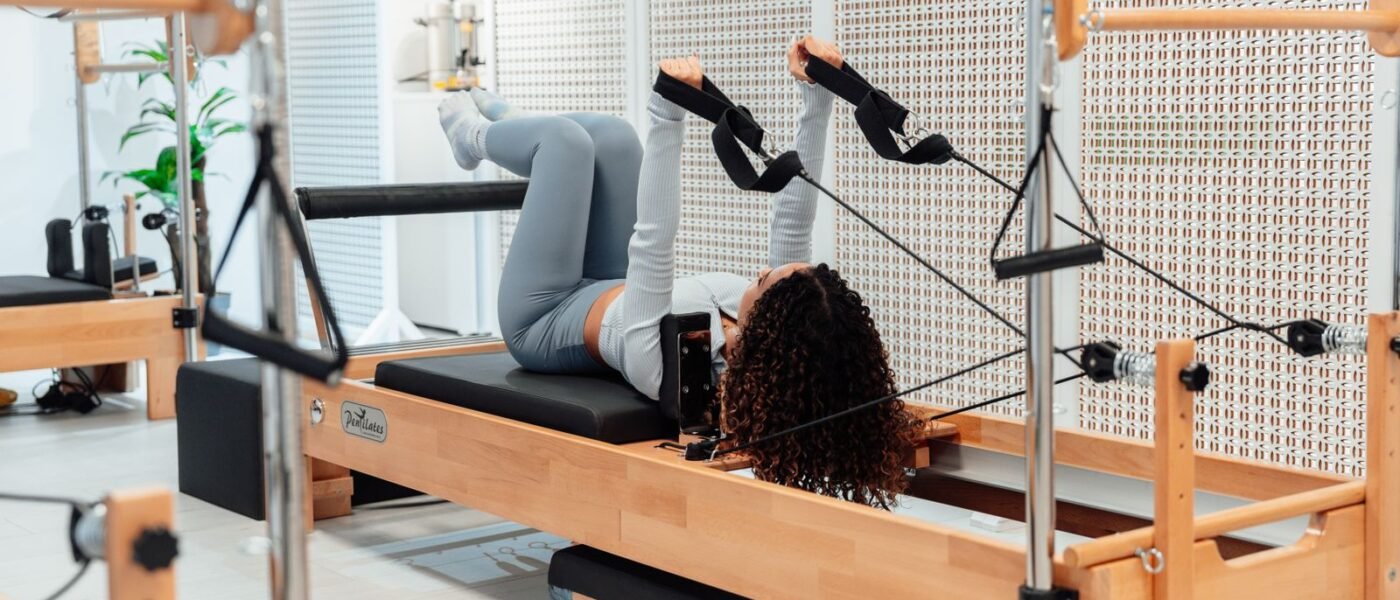
The elements found on virtually all machines:
- The carriage, on which you lie down, sit, or kneel. It has a headrest and two shoulder blocks.
- The springs, usually four or five, of different tensions. You attach one or more to adjust the resistance. Their color code varies by brand.
- The foot bar, at the front, adjustable in height, to push with your feet or hands.
- The straps and pulleys, at the back, into which you slide your hands or feet.
- The accessories often sold with the machine: the box, a box placed across the carriage, and the jumpboard, a bounce board that replaces the foot bar.
The reformer was designed by Joseph Pilates, the inventor of the method, who developed it in his New York studio from the late 1920s onward. He called his method “Contrology”: the idea was to control each movement rather than chain repetitions. The machine serves exactly this purpose.
How a reformer session goes
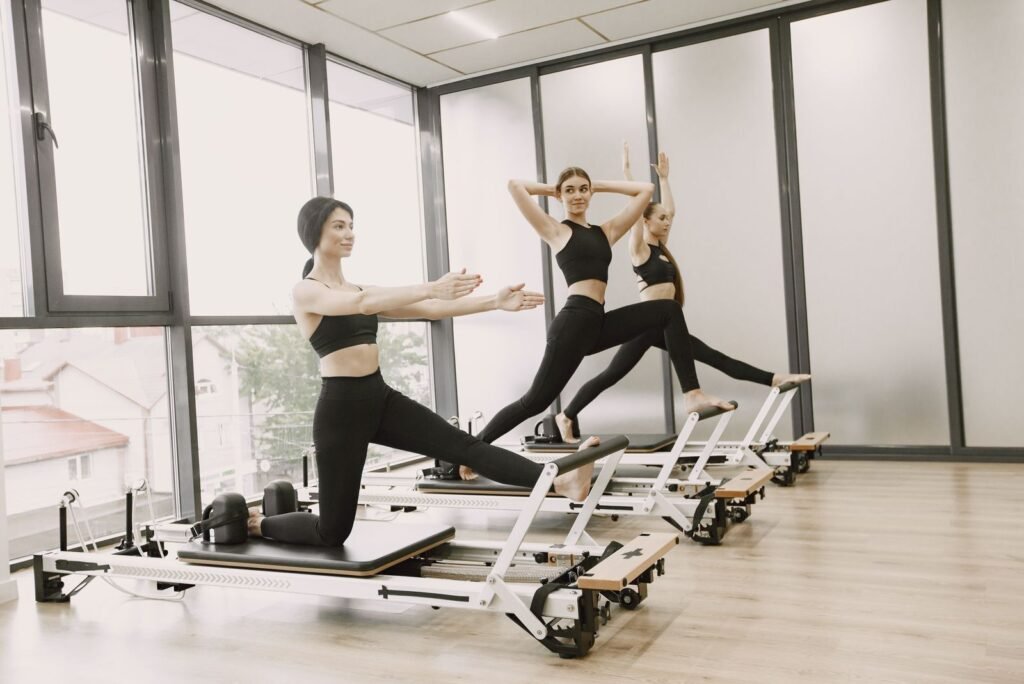
In a studio, a group class typically lasts 45 to 55 minutes and brings together a handful of students, each on their own machine. It almost always begins lying on your back with “footwork”: feet on the bar, you push the carriage and bring it back, changing the position of your feet. It’s the warm-up, and it’s already more demanding than it seems.
What follows chains exercises lying down, sitting, kneeling, or standing, often with feet or hands in the straps. The instructor announces the spring setting before each exercise. The pace stays slow: you’re looking for regular breathing, a stable pelvis, and clean movement, not speed.
The point that surprises beginners: fewer springs doesn’t always mean easier. On many exercises, the spring stabilizes you. With a light setting, the carriage becomes “free” and you need much more core strength to control it. This is what makes the machine so adaptable.
What the reformer really brings
Pilates has been the subject of numerous studies, of unequal quality. The most solid results concern strengthening the core muscles, flexibility, and, in people who suffer from chronic back pain, a reduction in pain compared to no activity. A Cochrane review published in 2015 on chronic back pain concludes in this direction, while noting that Pilates does not perform better than other well-conducted forms of exercise. It’s a good tool, not a separate treatment.
More concretely, here’s what regular practitioners most often observe:
- Deeper core engagement. The carriage is always moving: to stay stable, the deep abdominals, glutes, and back muscles work constantly, even during a leg exercise.
- Work in resistance. Coming back slowly against the springs works the muscles as they lengthen. It’s demanding, but gentle on the joints.
- More range of motion. Many exercises combine strength and stretching, particularly in the back of the thighs, hips, and shoulders.
- Better postural awareness. The machine makes imbalances visible: if one leg pushes more than the other, the carriage shows it right away.
- Low impact. No jumping or shock, except on the jumpboard. This is one reason why the reformer is used in rehabilitation, with a professional.
What it doesn’t do, on the other hand: melt away belly fat in a few weeks. The reformer remains a moderate intensity activity. It refines the silhouette because it tones and straightens, but weight loss mainly depends on diet and overall activity. The calorie numbers circulating online vary from one to three times depending on the source; if this interests you, a heart rate monitor will give you a personal estimate, much more meaningful than an average.
Reformer or mat Pilates: the real differences
The method is the same, the principles too: breathing, center, control, precision. What changes is the resistance. On the mat, you work with your body weight, sometimes a small accessory. On the reformer, springs add a load or assistance that you adjust for each exercise.
| Criterion | Mat Pilates | Reformer Pilates |
|---|---|---|
| Resistance | body weight, small accessories | adjustable springs |
| For a beginner | some exercises are hard from the start | springs can assist the movement |
| Variety | broad, but limited by gravity | very broad: lying down, sitting, kneeling, standing |
| Cost of a class | the most affordable option | noticeably more expensive, especially in major cities |
| Equipment at home | a mat is enough | a machine, and space to unfold it |
| Where to practice | everywhere | in a studio, or at home with your own reformer |
The two complement each other very well. Many practitioners do one reformer class a week and one or two short mat sessions at home, with a ring or small ball. If you go with this formula, our Pilates accessories page sorts out what really works and what clutters.
How long before you see results?
Joseph Pilates is credited with a famous quote: in ten sessions you feel the difference, in twenty you see it, in thirty you have a new body. It remains a good guideline provided you read it as an order of magnitude, and with regular practice.
In reality, with two or three sessions per week:
- After a few sessions, you master the machine better and feel muscles you never engaged before, often under your glutes and in your lower belly.
- After about a month, the basic exercises become more fluid, your posture changes, you stand straighter without thinking about it.
- After two to three months, the difference becomes visible: a tighter belly, better hip flexibility, a less stiff back at the end of the day for many practitioners.
One session per week maintains, but progresses slowly. Beyond four sessions per week, gains become minimal if other days aren’t devoted to recovery.
The advantages and limitations of the reformer
The reformer has real strengths: it adapts to almost all levels, it makes exercises more readable, it allows long-term progress by simply changing springs, and it’s gentle on the joints. It’s also a very guided method, reassuring for those who don’t like weight training rooms.
Its limitations are mainly practical. Classes are expensive over time: at two sessions per week, the monthly budget quickly becomes significant, especially in a major city. Time slots are limited, studios concentrated in cities. And at home, the machine takes up space: a studio model is nearly 2.40 m long, not counting the space to move around it.
This is why home reformers are developing, notably foldable models. We’ve compared the numbers that matter in our guide to the foldable Pilates reformer: unfolded length, footprint when folded, weight to lift. For an overview of available machines, fixed or foldable, see our selection of Pilates reformers for the home.
For whom the reformer is not recommended without medical advice
The reformer is gentle, but that’s no reason to start on your own in certain situations. Consult your doctor or physical therapist before beginning, then prefer supervised classes if you’re in one of these cases:
- pregnancy, or recent childbirth;
- herniated disc, sciatica, or acute back pain;
- recent surgery, particularly of the back, hip, knee, or shoulder;
- osteoporosis, because certain back flexions are to be avoided;
- uncontrolled high blood pressure or heart condition.
In most of these cases, Pilates remains possible and often recommended, but with selected exercises and someone trained to adapt them. A good instructor will ask you about this in your first class.
Where to start?
If you’ve never practiced before, the easiest way is to book two or three trial classes in a studio. Many offer a discovery rate. You’ll quickly know if the method suits you, and you’ll learn the basic settings: bar height, headrest position, spring choice.
If you’re hooked and classes are straining your budget or schedule, a home reformer becomes cost-effective after a few months of regular practice. First measure your room, then compare models: our Pilates reformers page sorts them by budget and footprint. And if you’re hesitant between a more complete machine, with a frame and bars above the carriage, our Pilates Cadillac page explains the difference.
Frequently asked questions
What is the difference between Pilates and reformer Pilates?
It’s the same method. “Classic” Pilates is practiced on the floor, on a mat, with body weight. Reformer Pilates uses a machine with a carriage and springs, which adds resistance or assistance depending on the exercise.
Is reformer Pilates suitable for beginners?
Yes, often more so than mat Pilates, because springs can facilitate certain movements. First sessions in a supervised class are still recommended to learn the settings and safe positions.
Does reformer Pilates help you lose weight?
It tones and reshapes the figure, but it’s a moderate intensity activity. Weight loss mainly depends on diet and overall physical activity. The reformer complements a more cardio activity well.
How many times per week should you do reformer Pilates?
Two to three sessions per week allow clear progress in two to three months. One weekly session maintains, but progress is slower.
Can you do reformer Pilates at home?
Yes, provided you have the space: a reformer is about 2 to 2.40 m unfolded. Foldable models can be put away after your session. A few studio classes before equipping yourself allows you to learn proper adjustments.
Sources: Cochrane review “Pilates for low back pain” (Yamato et al., 2015); pricing grids published by reformer Pilates studios in France, consulted in September 2026. This article is informational and does not replace the advice of a healthcare professional.